Every year, video game consouers around the country begin clamoring for the release of one game that begins its hype in April and climaxes with the release of the game in August. That game, of course, is the coveted, and haunted, Madden series.
Now I know those of you who don’t watch sports and read up on your video game twitter accounts, are asking yourself, what does he mean by haunted? How could a video game be haunted?
Well for years, pundits and critics have claimed that whoever graces the cover of the new Madden game that year is doomed to fail and fall under what sports enthusiasts everywhere have coined as the “Madden Curse.”
Let’s take a look at past cover boys and how the success of becoming the face of the video game industry’s best-selling franchise has affected their season that year.
The first was in 1999, when San Francisco running back Garrison Hearst was pictured on the cover of the game. He had a solid regular season (3rd in rushing), but in the NFL playoffs against the Atlanta Falcons, he suffered a severe broken ankle that required Hearst to miss two full NFL seasons. In 2000, Detroit Lions running back Barry Sanders was featured over Madden’s shoulder and how did Sanders fare that season? Well he retired abruptly in July before the start of the season.
In 2001, Tennessee Titans running back Eddie George was selected as the Madden cover boy and responded by failing to break 1,000 yards and his team missing the playoffs. Ex-Minnesota Vikings quarterback Daunte Culpepper flaunted his arm on the cover of the 2002 Madden game and during that season, he missed 4 games with injury, threw for 1300 less yards and 19 less TD's then in 2000.
See a trend yet? No? Well let me give you some more food for thought.
In 2003, St. Louis Ram’s running back Marshall Faulk had his picture plastered across the cover and during that subsequent year, Faulk rushed for 430 less yards and had 4 less TDs compared to 2001. Faulk's worst season since 1996. Coming into the 2004 version of the game, no player was hotter than Michael Vick, which gave the cover spot to the Atlanta Falcons signal caller. That year, however, Vick suffered a broken leg in the preseason and missed the first 11 games of the season, all stats were down from the previous year.
As for the 2005 season, the curse seemed to be broken with the installment of Baltimore Raven linebacker Ray Lewis. His numbers were slightly down from the year before but were still above the league average. He did, however, miss one game and failed to record an interception for the first time in his career. Also, he dropped a crucial interception in a playoff game against the Tennessee Titans that season which cost his team the game.
For Madden 2006, Philadelphia Eagles quarterback and savior Donovan Mcnabb suffered a hernia and was lost for the season after appearing on the cover. Mcnabb threw for more interceptions and his yards per attempt and completion percentage were down from 2004. The Eagles finished 6-10, in last place, and missed the playoffs for the first time since 1999
Seattle Seahawks running back Shaun Alexander was featured on the Madden 2007 cover of the game after a record-breaking previous season. That year Alexander missed 6 regular season games with a broken foot. He finished the season with 896 yards and 7 touchdowns, which were the lowest since his rookie season. For Madden 2008, the dubious title of Madden cover boy went to Tennessee Titans rookie quarterback Vince Young, who proceeded to have a ratio of 2 interceptions for every touchdown he threw that season.
Then for Madden 2009, the video game figured it would get around the curse by featuring Brett Favre, a recently retired Favre, in his Packers uniform. Well, the trick was on them as Favre un-retired and returned to play with the New York Jets. Favre and the Jets started the season hot, but after Favre injured his throwing arm, the season collapsed quickly. Favre threw 6 less TD's and 7 more int's then in 2007. The Jets finished 9-7 after starting 8-3 and missed the playoffs.
So what will happen with the release of the brand new Madden 2010 game, as Pittsburgh Steelers safety Troy Polamalu and Arizona Cardinals wide receiver Larry Fitzgerald were selected as the first ever duo cover boys. Is there really such a thing as a Madden Curse?
When thinking about it using general common sense, there is no way that becoming the poster boy for a video game series can affect your career. But when looking at the track record of the past players to grace the Madden cover, it is almost too spooky.
Critics have been talking about this ‘Madden Curse’ for years now and it continues to happen with each player. Is it really fate or is it merely a coincidence?
While people worry about whether Polamalu will get the hair yanked out of his head or if Fitzgerald will tear an ACL, the real video game fans are looking forward to the release of the game and so am I. In a recently released interview with “Madden NFL 2010” senior producer Phil Frazier, he gave a few hints as to what to expect with the new game, building the excitement for one of the most hyped games of the summer.
The first new feature of the game is a program called Pro-Tak. This new technology system “is a new animation technology that helps drive several new features in the game," Frazier said. "This includes nine-man gang tackles, a brand new pocket for the offensive line, steerable blocks, steerable tackles and the fight for the fumble feature that really lets you fight for that ball at the bottom of the pile.”
That’s right. a fight for the fumble feature. In perhaps the most exciting new feature to come about in any NFL franchise football game is this new piece of heaven. The fight for the fumble will allow you to scrum on the bottom of the pile, fighting for that elusive turnover, mashing buttons on your controller to keep the ball for your side. Never before have players been able to fight for the ball and Madden 2010 will give gamers the opportunity to do that.
Another sweet new piece of technology making its debut in the Madden 2010 game is the quarterback avoidance system. This system will allow you to continue to look downfield for receivers as the pocket collapses around you. When you have a defender breathing down the back of your neck, your controller will begin to rumble and you have a second to flick a button to hopefully avoid from becoming that player’s sack lunch.
Other features in the game include the introduction of the “Wildcat” offense which, for those of you who have no idea what a wildcat is, is when the running back assumes the position of quarterback and then with a running back next to them can either hand off or run it themselves. They can also throw the ball if you have a really athletic quarterback.
The whole purpose of these new features is to make the game as real as possible, to bring what you see during games on Sunday into your game console. The Madden franchise has continually provided excellence in the field of sporting games, proving to be the leader in technological advances in the field, making the game as real as possible. The series has been able to remain a mainstay in popular culture and continues to be a giant in the video gaming industry.
Madden 2010 looks to build on the previous success of the franchise and with these new features, there is no doubt that the 2010 reincarnation of the game will prove to be the best yet.
The jury is still out, however, in regards to the curse, but we’re only 3 months from release and 4 months away from seeing if the Madden Curse will strike again.
Thursday, April 30, 2009

Tuesday, April 28, 2009
Monday, April 27, 2009
Thank God for that catchfence

Countless lives were saved yesterday by a fence.
That's right, a fence. But this isn't your common, everyday white picket fence, it is referred to by NASCAR officials as the "catchfence". This fence surrounds the track, particularly in front of the massive crowds that venture their ways to the speedways to cheer on their favorite drive. These fences were created to stop large pieces of debris from becoming unattached from cars and ending up in the crowd's lap. The fact of the matter is this, take a crash at 200 miles per hour, have a wheel come off and shoot it into the crowd and it is a fatal projectile sure to take more than a few lives.
It's not common for crowds to show up in numbers of excess of 100,000 to these events, making a crash into the stands a potentially tragic and horrific scene. This is why NASCAR and safety researchers created the catchfence to be put around the track and reinforce it where there are fans. But with nothing to really test it, as 99% of crashes stay on the track, it is almost impossible to tell what a full speed crash would do to these fences. Would it hold against the weight of a car? Sure the fence might be strong enough to take a tire or something that isn't a two ton hunk of metal spiraling through the air. Well let's set the scene for Sunday's NASCAR race at Talledega and show you how a fence turned certain death for hundreds of fans into minor injuries for only 8 spectators.
Carl Edwards and rookie Brad Keselowski are bumper-to-bumper during the final lap of a wreck filled race. Already there has been two accidents that have involved at least ten cars and what was about to occur next would have fans kissing the feet of the men and women who designed this fence. Edwards was in the lead going into the final turn as Keselowski was hooked onto his bumper, looking for that one opportunity to make a pass.
Keselowski went down. Edwards with the block. Keselowski went up. Edwards went for the block. But as Edwards went for the block, Keselowski made his move back down to the inside part of the track, poised for the pass on Edwards. As Edwards came down for the block, Keselowski was already inside of him, pitting his back side against the other driver's hood, sending Edwards sliding to the left.
In order to slow cars down during a crash, racecar engineers installed flaps on the roof, much like on the wings on an airplane to slow it down during the landing. Well these flaps caught the air flow around his car moving sideways and lifted his back end up off the ground. This would've been fine except for the car behind Edwards had too little room to do anything and ended up being a catapult to Edward's car. Edwards's car began to fly through the air end over end and it was going toward the crowd for almost certain death.
But a metal fence stood between the crowd and Edward's flying car taking the full force of the accident, bending back as this car hit it going 140 miles per hour in the air.
It didn't break. It did it's job.
Edwards was able to climb out of his car as it came to a rest short of the finish line and he ran across it to get the points, alas shades of Ricky Bobby. But looking at his car and watching the crash from all different angles has to leave fans wondering what if. What if that fence didn't hold, what if the car made its way through that barrier and ended up crushing many helpless fans on the front row?
All of that goes back to thanking their lucky stars that individuals were able to create a fence strong enough to take the blow of a carsh this intense and not break. Now, each driver and fan has their own opinion of the crash and the safety equipment, but the bottom line is this: Edwards was able to walk away from a crash where his car flew through the air and hit a metal fence at 140 miles per hour. Fans in the path of this metal tornado were able to go home and tell the story of their survival, about the fence that saved their life.
Countless lives were saved by a fence yesterday. Who knows what would've happened had it failed to stay standing.
Saturday, April 25, 2009
And the with the first pick...
Teams begin planning for today the day after their season ends, going through team inventories and grading each area. General managers, coaches and scouts replace their 24/7 study of game film with game film of the next great college prospects. Sports stations across the country turn to covering today more than three months in advance, covering everything from the athlete's 40-yard dash time to their barber's name when they were a kid. If that's not enough, they dedicate their own show to the next two days, instead of incorporating it with the other highlights.
For fans, these two days are where hope can be found in your team, camping out in front of the television, awaiting who will become the next possible future face of the franchise. These next two days will determine how your team's season will begin and can you give you more or less reason to hate other teams.
I am, of course, talking about the NFL Draft, which began today to a less than climatic boom, as the No. 1 pick was already signed by the team two days before the draft began. Georgia QB Matthew Stafford was selected and signed by the Detroit Lions with the No. 1 selection in the 2009 NFL Draft. Last season the lowly Lions finished a dismal 0-16, the first team in NFL history to not win a game in a season (since the schedule was changed to 16 games in the mid 1980's).
But as for the rest of the Draft, it was a mystery. Each team has needs to be filled, but there is always one question that must cross the minds of every coach and general manager as the time becomes theirs to pick: do I pick a player that fills the needs of our organization or do I draft the best available player when it becomes our turn? Rarely do those two ever meet one another and if they do, it is only because the team is so terrible and has so many needs, that it is inevitable that the best available player will match-up with their needs.
My favorite team, the Green Bay Packers, faced this similar situation in today's first round of the Draft. The Packers were very raw on defense last year and need help, giving up game-winning drives in the last minutes to finish 6-10 on the year. So defense was a main concern going into the Draft and with the number 9 pick, they could address it. But no one saw it coming when perhaps the best player in the draft fell directly into their laps in Texas Tech wide receiver Michael Crabtree. The only problem was that their main target, Boston College defensive tackle B.J. Raji, was still on the board and would fill in a huge need.
So what is GM Ted Thompson going to do? Is he going to go with the sure fire need for a defensive tackle to help the league's 26th worst run defense, or does he draft the explosive Crabtree to improve a wide receiving corp that doesn't really need help?
Well I guess this is why they get paid the big bucks to make decisions like this, because I would have selected Crabtree in a heartbeat. Crabtree is a playmaker who can be a game changer, while Raji can be the same thing, but on a less consitent basis. While Raji will be the anchor of a defensive line that is switching from the normal 4-3 base defense to the new 3-4 defense that so many NFL teams are now going to.
The Packers ended up with two first round selections and went with defense both times, Raji at No. 9 and USC linebacker Clay Matthews at No. 26. Both of these picks will help the Packers transition into that 3-4 defense.
I still will always wonder what it would've been like to see Crabtree on the back of a Packers jersey as he makes the Lambeau Leap. *sighs*
Thursday, April 23, 2009
Column 3 Rough Draft
Waiting for the clock to strike Midnight: An After Midnight Project Review
“You will hear us on rock radio.”
Those were the words of Danny Morris, a drummer for a little known band called the After Midnight Project. AMP is a group that hails from Los Angeles and is on a hellbent path of destruction to future rock band stardom.
The After Midnight Project describes their music as catchy and edgy, using their lyrics to pull in the listener and never let them go, beating them over the head with hard rock riffs and screaming vocals but then bringing them back down to earth with melodic choruses and soothing verses. This creates a musical mix that gives them a sound all their own - and they know it.
“We’re not trying to reinvent the wheel when we create music,” said lead singer Jason Evigan. “We combine all of these different elements to make the listener want more.”
On Saturday April 18, the After Midnight Project brought their high energy circus act to the Health and Sports Center to kick off the party in regards to the release of their new album, Let’s Build Something to Break, scheduled for release on July 14. It will be the band’s first album release with major label Universal records.
As an opening act, their name was nowhere to be found on the promotional items and was an underscore next to the two other groups set to perform that night. But being an underdog before has never stopped this band from living its dream of making music.
“We started as a band in 2004, and while there have been several reincarnations of the band, we have never lost sight of our main goal,” Evigan said. “And that goal is to keep making music as long as we can and enjoy every minute of it while doing it.”
After watching this band roll up to the venue in a van and U-haul, dwarfed in comparison to the extravagant and luxurious tour buses provided by the other acts, it was hard to tell what this group would bring to the table. But after interviewing them in their locker/dressing room, it was easy to tell that this group of five musicians had confidence - and a burning desire - to absolutely blow this crowd away.
The stage was set and floor was filled with students eager to hear great music, unaware that this little rock band was waiting in the back, ready to put their hearts on their sleeves and give it to the crowd. As the lights dimmed, the crowd erupted into a nervous cheer, not knowing what to expect of the band getting ready to take the stage.
Immediately the band opened up with a track off of their 2006 EP, titled “Digital Crush”, which featured edgy singing by Evigan, magnificent guitar playing by Spencer Bastian and Christian Meadows and hard hitting sets from drummer Danny Morris. Being next to the stage, you could see the determination and emotion in Evigan’s eyes, pouring everything he had into that microphone.
Song after song, the band threw curveballs that even threw me by surprise. Before the show, Bastian has told me that to “expect a show that would get the crowd flowing because we pride ourselves on having a high energy performance, something the audience will remember when they go home.”
Boy, did they get the crowd moving. Looking at the concert through my camera, I could see the impact these men were having on the Kearney faithful. The storms going on outside at the time could not compare to the electricity flowing through the crowd during the band’s entire performance.
The After Midnight Project did something that no other band did that night: they connected with the crowd on a personal level. The words that flowed from Evigan’s mouth to the notes being strummed by Meadows, all implanted into the ears of everyone in the crowd. Just like a fish on a string, they were reeled into world the band wanted to create for them.
“The songs - the music and the words - speak to a lot of people,” Bastian said. “I think that is what the fans get out of it the most.”
With word spreading quickly of the band’s performance, don’t be surprised to turn the dial and hear the After Midnight Project coming through your speakers. It’s only a matter of time before people from Kearney can watch MTV and say, “hey, I saw that band live!”
Monday, April 20, 2009
Photoblog: Secondhand Serenade
Here a few photos I selected from the Secondhand Serenade portion of the concert. These images will be smaller to save space, but click on them to make them larger.


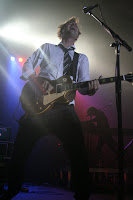


Photoblog: After Midnight Project
These are a few photos I selected from the first performance of the night, the After Midnight Project.


Subscribe to:
Posts (Atom)